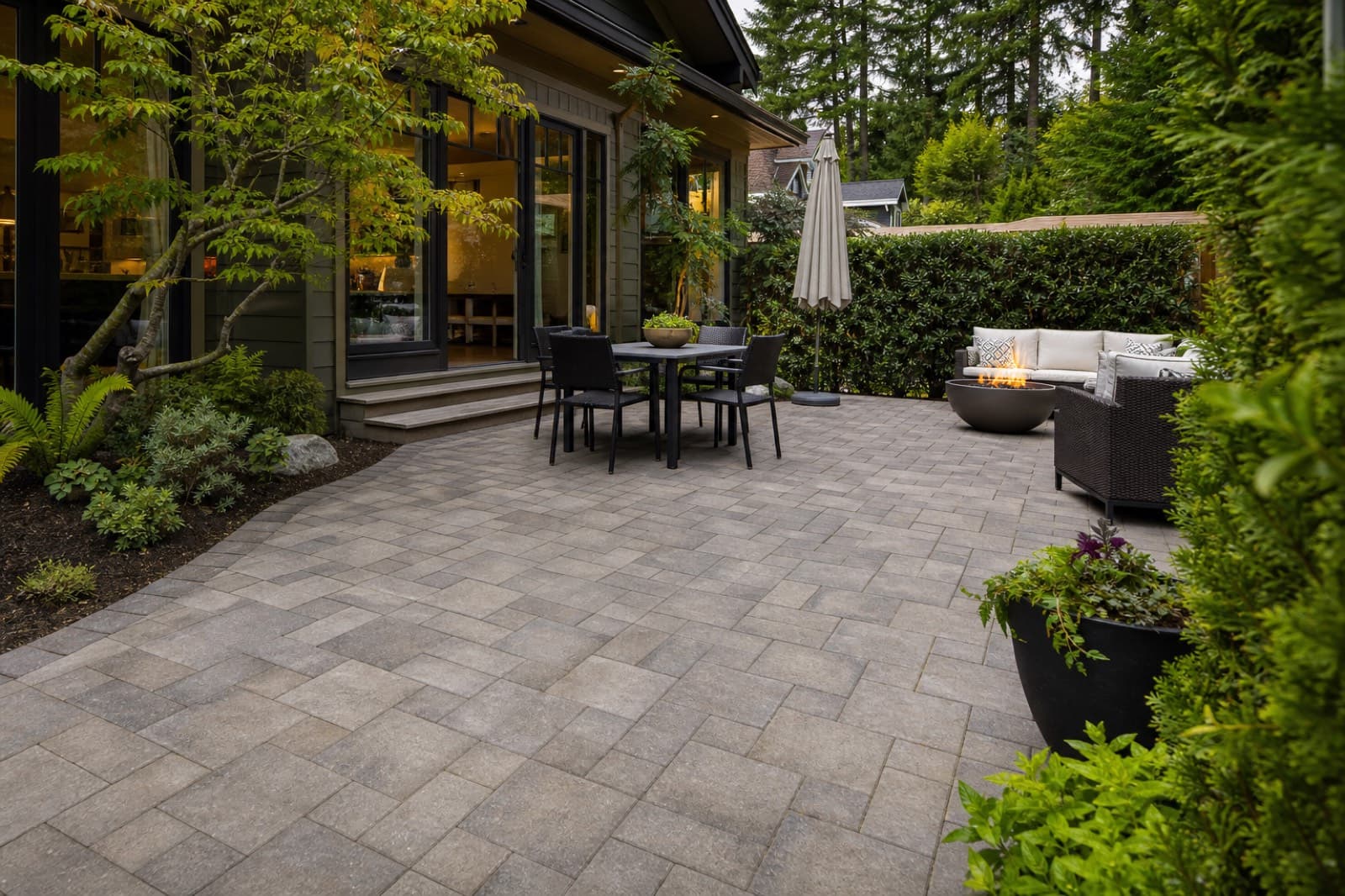
When homeowners plan a patio or walkway, the first decision is usually pavers or a poured concrete slab. Both can look great and both have their place. But our climate here on the West Coast, all that rain plus just enough freezing, tends to favour one over the other for most outdoor surfaces. Here's an honest look at how each holds up, so you can make the right call for your yard.
How a poured slab handles our weather
Poured concrete is one continuous, rigid surface. That's its strength and its weakness. It's smooth and solid, but because it can't flex, it cracks. And in the Lower Mainland it gets a lot of help cracking: water soaks into the ground beneath it, freezes, heaves the slab, and a crack opens. Once water gets into that crack the cycle accelerates.
When a slab cracks or a section heaves, your options are limited. You can't replace one piece. You're patching it, which always shows, or breaking out and repouring a whole section. A poured patio that's lifted at one corner is a common and frustrating sight around here.
How pavers handle it
A paver surface is made of many small units sitting on a compacted gravel base and bedding sand. Because it's segmental, it flexes with the ground instead of fighting it. Freeze-thaw that would crack a slab just gets absorbed across all those little joints.
And if something does go wrong, say a tree root lifts one corner, you lift the affected pavers, fix the base, and reset the same pavers. No patch, no colour mismatch, no repour. For a wet, freeze-thaw climate like Port Moody's, that flexibility is a real advantage.
The catch with pavers: the base
Pavers are only as good as what's under them. The whole system depends on a properly excavated, deeply compacted gravel base. Done right, a paver patio stays flat for decades. Done cheap, on a thin or poorly compacted base, it heaves and ruts within a couple of winters and people blame the pavers.
This is the part to ask about when you're getting quotes. How deep are they excavating? Are they compacting the gravel in layers? Is there edge restraint to keep the pavers from spreading? The answers tell you whether you're getting a patio that lasts or one that fails early.
Looks, grip, and repairs
Beyond durability, a few practical points:
- Grip: textured pavers give better footing in the rain than smooth wet concrete
- Look: pavers come in countless patterns and colours; concrete is more limited unless you stamp it
- Repairs: pavers are spot-fixable, concrete usually isn't
- Drainage: paver joints let some water through, easing runoff
- Cost: a basic slab can be cheaper up front, but factor in how each ages
So which should you choose?
For most patios, walkways, and even driveways in Metro Vancouver, pavers on a proper base are the more durable, more repairable, better-looking choice for our climate. A poured slab still makes sense in some situations and on a tight budget, as long as you go in knowing it will likely crack eventually.
Whichever you pick, the base is what determines how long it lasts. That's true for both. The single best thing you can do is hire someone who doesn't rush the part you can't see.