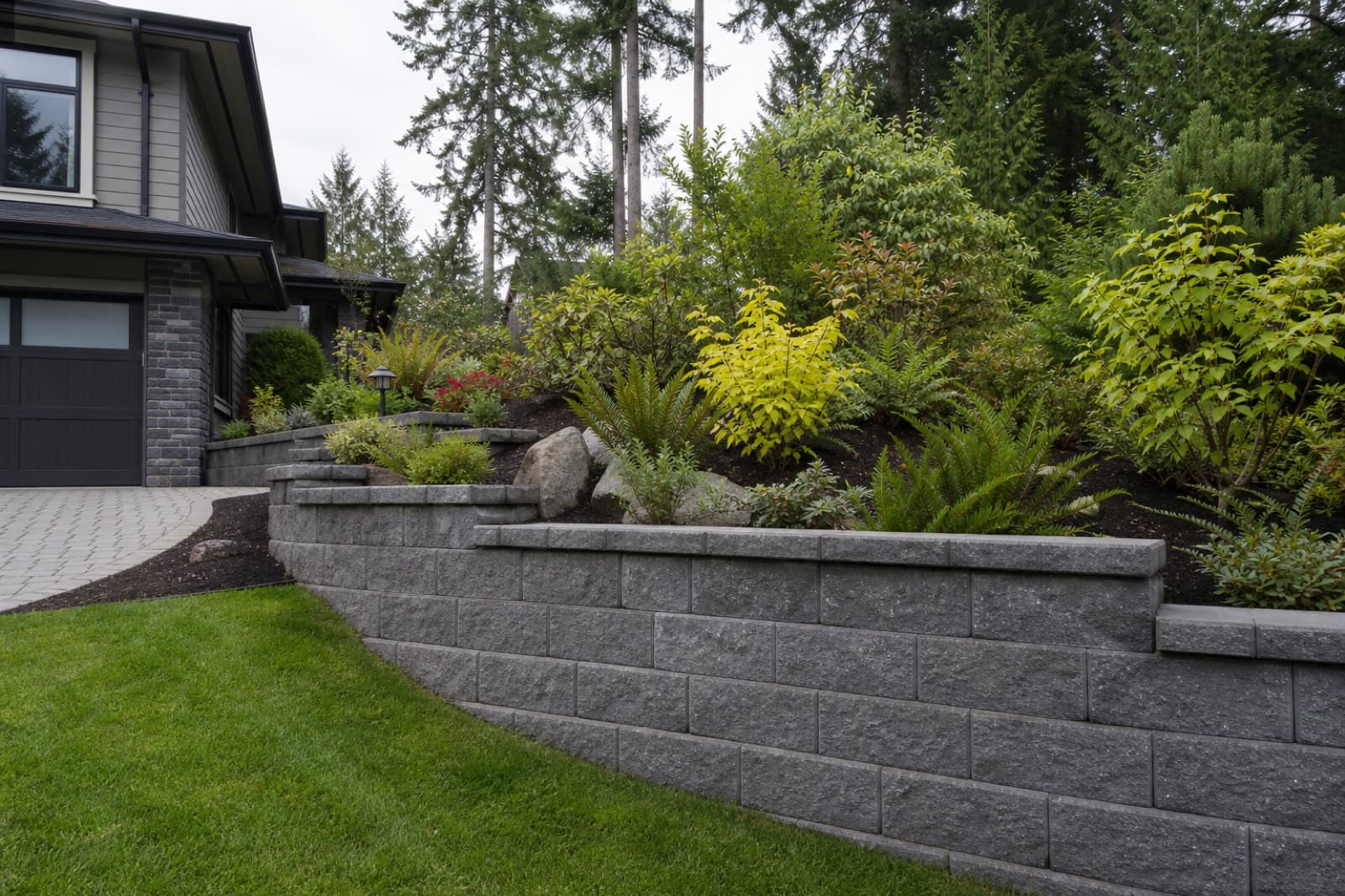
Burnaby is a city of hills, and so are most of its neighbours. Coquitlam climbs up Burke Mountain, North Van runs up the slopes, and half the lots in between sit on a grade. That means a lot of retaining walls. It also means a lot of failed retaining walls, because the things that make a wall last are almost entirely hidden once it's built. Here's what actually keeps a wall standing, and why so many of them lean, bulge, and let go.
Walls don't fail from the front
When people picture a retaining wall failing, they imagine the soil being too heavy and pushing the wall over. That's part of it, but it's not the real story. The real culprit is water.
Soil behind a wall soaks up rain, and our region gets a lot of rain. Saturated soil weighs far more than dry soil and it exerts what's called hydrostatic pressure: water pushing sideways against the back of the wall. A wall built to hold dry soil can be destroyed by the weight of waterlogged soil. That's why the two things that actually keep a wall standing are both about managing water.
Reason one: drainage behind the wall
A properly built wall has a layer of clear gravel behind it and a perforated drain pipe at the base. The gravel gives water somewhere to go instead of building up in the soil, and the pipe carries it away. This is the single most important detail in the whole wall, and it's invisible the moment the wall is finished.
It's also the first thing cut to save money or time. When you see a wall that's bulging outward or leaning after a few years, the odds are very high that someone backfilled it with dirt straight against the block, no gravel, no pipe. The water had nowhere to go, the pressure built, and the wall lost.
Reason two: the base
The second hidden essential is the base the wall sits on. A retaining wall needs a trench excavated below grade and filled with compacted gravel, built up in layers and tamped down hard. That compacted base spreads the load and gives the wall a stable footing that won't settle.
Skip it, or just lay the first course on dirt, and the wall settles unevenly. One section drops, the wall cracks or tilts, and the clean lines you paid for are gone in a couple of winters. On Coquitlam's steeper Burke Mountain lots especially, where the soil and slope are already working against you, the base is not the place to save a day.
When you need an engineer
In most Metro Vancouver municipalities, a retaining wall over about 1.2 metres (4 feet) needs a permit, and usually an engineer's design. Taller walls carry serious loads, and on a slope those loads add up fast. Geogrid, a reinforcing mesh that ties back into the soil behind the wall, often comes into play here.
This isn't red tape for its own sake. A tall wall that fails can take a chunk of your yard, or your neighbour's, with it. If your project is over that height, build it with the engineering and the permit. A good mason handles that coordination as part of the job.
Block or natural stone?
Both work well, and the choice is mostly about look and budget. Segmental block walls go up faster and give a clean, modern, uniform line. Natural stone takes more skill and time but gives a rugged, timeless look that suits a lot of West Coast properties.
What matters more than the material is what's behind it. A beautiful natural stone wall with no drainage will fail just as surely as a cheap block one. Whatever you choose, the gravel, the pipe, and the compacted base are what you're really paying for.